
How to lay sandstone paving
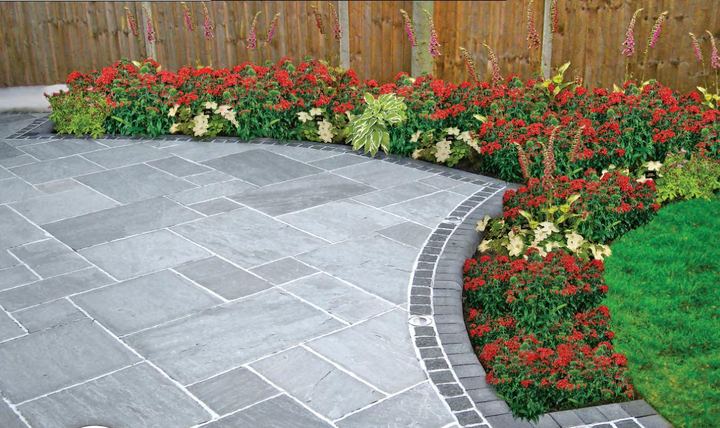
Sandstone paving lasts for decades when the base, the bed and the joints are done properly. This guide covers the usual method for a patio of sawn or natural sandstone slabs. Always follow your installer's specification and local rules.
Before you start
- Open every pack and mix the slabs. Natural stone varies in colour. Draw slabs from several packs as you lay so no one area looks darker or lighter.
- Dry lay a section. Check the pattern, the colour balance and the sizes before any mortar is mixed.
- Set your levels. The finished surface should fall away from the house at about 1 in 80, which is roughly 12 mm per metre. In the UK, keep the finished level at least 150 mm below the damp-proof course.
Step by step
1. Excavate
Dig deep enough for the sub-base, the mortar bed and the slab. For a normal patio that is typically 100 mm of sub-base, a 35 to 50 mm bed and a 20 to 30 mm slab, so around 170 to 190 mm in total. Remove topsoil and soft ground.
2. Build the sub-base
Spread crushed stone (Type 1 in the UK) in layers and compact each layer with a plate compactor. A firm, level base stops slabs settling. Shape the fall into the sub-base, not into the mortar.
3. Lay a full mortar bed
Mix semi-dry mortar, commonly around 4 parts sharp sand to 1 part cement. Lay a full bed under the whole slab. Avoid the five-spot method of dabs at the corners and centre, which leaves voids that fill with water and crack slabs.
4. Prime the back of each slab
Brush a bonding slurry of cement, water and a bonding agent on the back of the slab. This helps it bond to the bed, especially on porous stone.
5. Place and level
Set the slab on the bed, tap it down with a rubber mallet and check level and fall with a spirit level. Keep joints even, typically 8 to 10 mm. Sawn slabs allow tighter joints than natural split slabs. Use spacers if it helps.
6. Seal before you point
Sandstone is porous and mortar can stain it. Many installers apply a sealer to the slabs before pointing, then seal again at the end. Test on an offcut first.
7. Point the joints
Wait 24 to 48 hours so the bed can set, and keep foot traffic off. Fill the joints with a pointing mix made for natural stone. Press it in with a pointing iron, keep it off the slab surface and brush off dry residue.
8. Clean and seal
When the pointing has cured, clean the surface and apply a penetrating sealer. See our sealing and cleaning guide.
Cutting safety. Sandstone dust contains silica. Cut outdoors, use water to suppress the dust and wear a dust mask and eye protection.
Common mistakes
- Laying on dabs of mortar instead of a full bed.
- Building flat with no fall, so water pools.
- Skipping the sub-base or not compacting it.
- Pointing before the bed has set.
- Laying in frost or heavy rain.
- Using acid cleaners on limestone, which etches the surface.
Not sure how many slabs you need? Use the paving calculator.
Planning an order?
Tell us the stone, sizes, finish and quantity. We reply with a quote and can send samples.
Enquire on WhatsAppEmail: vs.exm@yahoo.co.in