

Sawn, honed or riven: what you are paying for
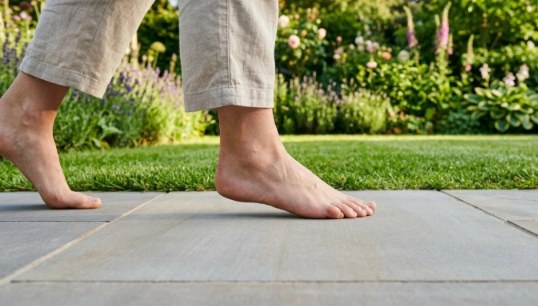
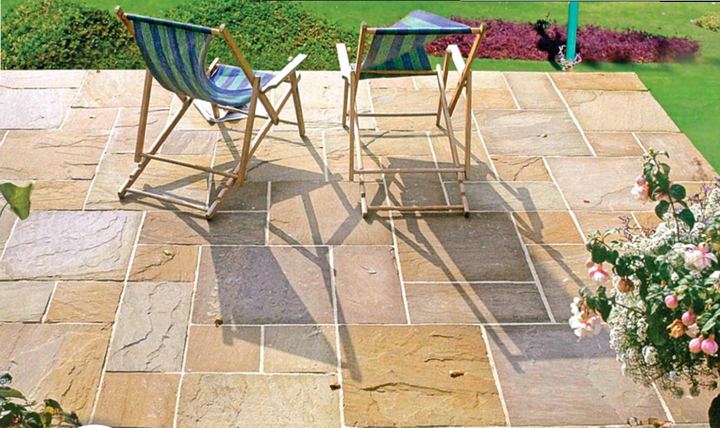
Two surfaces, two looks. Here is how sawn and natural split sandstone differ and how to pick.
| Sawn surface, sawn edges | Natural surface | |
|---|---|---|
| Look | Flat, clean, modern | Textured, rustic, split-stone character |
| Joints | Tight, even joints possible | Wider, slightly varied joints |
| Grip | Smoother; check suitability for wet areas | Textured surface gives more grip |
| Laying | Easier to keep level | Needs care with uneven faces |
| Best for | Contemporary patios and large formats | Traditional gardens and informal looks |
Three surfaces, one stone
The same block of sandstone can be finished in different ways, and the finish changes how the patio looks, feels and costs to lay. These are the three you will meet most often.
Riven (natural split)
The slab is split along its natural bedding plane, so the face keeps the ripples and ridges the stone formed with. Edges are usually hand-dressed and slightly irregular. It gives a traditional, textured look and good underfoot grip.
Sawn
The slab is cut by saw to size. The face is flat and the edges are straight, which means slabs sit tight and joints stay narrow and even. This is our specialty: sawn surface with sawn edges.
Sawn and honed
A sawn slab is ground smooth for an even, matt face. Colour variation shows less, and the surface reads clean and contemporary. Honed stone is smoother underfoot than riven stone, so think about wet areas, slopes and steps.
What you are paying for
- Processing. Sawing, calibrating and honing take machine time. A more processed surface usually costs more to produce than a split one.
- Accuracy. Sawn slabs are cut to size, so thickness and dimensions are tighter. That saves time on site and gives a neat finish with narrow joints.
- Waste and yield. Cutting and trimming affect how much of each block becomes usable slab.
- Laying. Even slabs lay faster and need less adjusting. Riven slabs with uneven faces need more skill and more mortar bed care.
- Look. Riven suits traditional gardens. Sawn and honed suit modern terraces and large formats.
Which should you choose?
- Modern house, clean lines, large slabs: sawn or sawn and honed.
- Cottage garden, informal planting: riven.
- Pool surround, steps or a wet slope: ask about grip and request a slip-resistance test report for the exact finish.
- Unsure: order a sample of each from the same stone and look at them outside, wet and dry.
Our approach
Sawn surface with sawn edges is our specialty, and we also supply natural surface. Other finishes can be discussed on request. See the stone range and how to lay paving.
Tips
- Ask for a sample in the exact finish you plan to buy.
- For pool surrounds and slopes, think about slip resistance and ask for a test report.
- Seal both finishes. See sealing and cleaning.
Planning an order?
Tell us the stone, sizes, finish and quantity. We reply with a quote and can send samples.
Enquire on WhatsAppEmail: vs.exm@yahoo.co.in